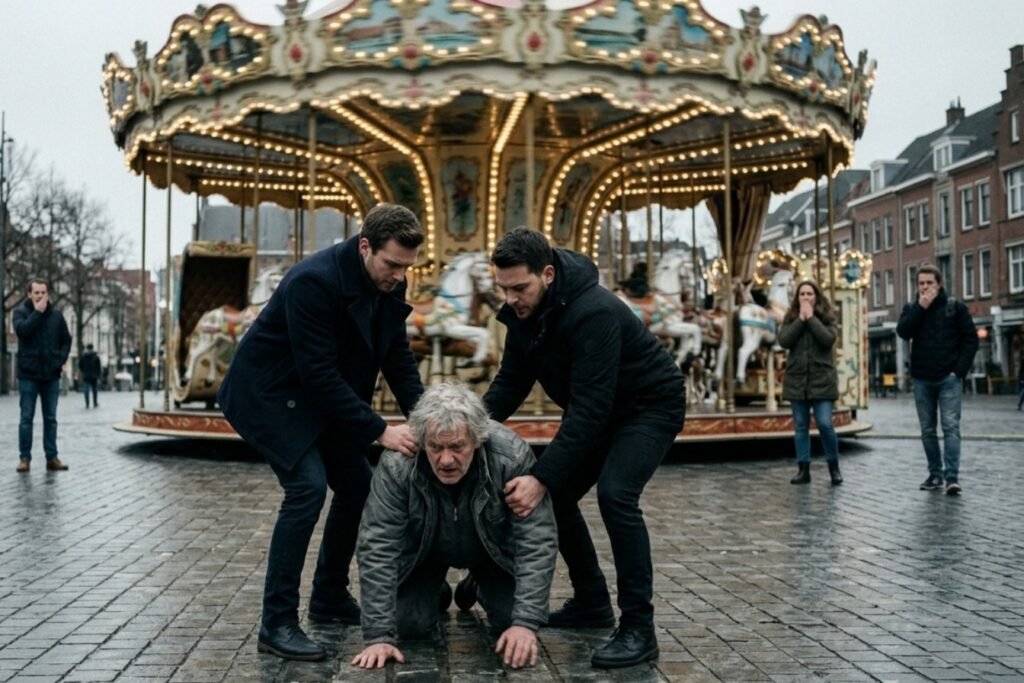
The plan Dominic built over the following two days was, in his own words, “elegant enough to work and simple enough that nothing complicated could get Lily hurt in the process,” which I understood to mean he had rejected at least a dozen more dangerous versions before settling on this one.
It worked like this: word would reach Victor Kessler, through channels Dominic assured me were reliable without explaining exactly what that meant, that Dominic Moretti would be taking his son to a charity carousel event downtown on Saturday, a low-security, publicly announced appearance he made every year, the kind of routine, photographed outing a man like Kessler would recognize as a rare, predictable window.
Except this year, Ethan wouldn’t be the one riding that carousel.
A carefully selected decoy, a boy from the security team’s own family close enough in age and build to pass at a distance, would take Ethan’s place, bundled in the same jacket Ethan had worn to the same event the year before. Ethan himself would stay home, safely upstairs with Lily and Dr. Harris. Every inch of the carousel and the surrounding plaza would be quietly seeded with Dominic’s men, positioned to look like nothing more than a busy Saturday crowd.
“And if he doesn’t take the bait?” I asked, standing in the study while Marco ran through the final positions on a printed map spread across the desk.
“Then we’ve lost nothing,” Dominic said, “and we try something else next week. But I don’t think he’ll wait. He’s been patient for nine years. Now that he’s shown himself twice, that patience is running out faster than he expects it to.”
Lily, to my surprise and considerable relief, had no role in the plan at all. Dominic had been absolute on that point from the first conversation. “She’s already given us everything she can,” he’d said. “I won’t put her anywhere near him again, not even at a safe distance, not for any reason.”
Saturday arrived gray and overcast, which Marco said was good, fewer families meant fewer bodies to track, and by ten in the morning I stood exactly where Dominic had asked me to, in a small coffee shop across the plaza with a clear line of sight to the carousel, my phone in my hand and my heart in my throat.
The decoy boy rode the carousel twice, laughing convincingly, flanked at a careful distance by two men dressed as ordinary fathers. I watched the crowd instead of the ride, scanning every gray jacket, every man sitting too still on a bench, every face that lingered a half-second too long in one direction.
It was nearly eleven when Marco’s voice crackled quietly through the earpiece I’d been given for the day, the first update in almost forty-five minutes.
“Contact. North entrance. Confirmed visual.”
My whole body went rigid.
Through the coffee shop window, I watched Victor Kessler walk into the plaza alone, hands in his coat pockets, moving with the unhurried calm of a man who had rehearsed this moment more times than anyone should ever rehearse anything. He didn’t look at the carousel directly. He circled it instead, the way a man circles something he’s afraid of getting too close to too soon.
“He’s clocking the crowd,” Marco murmured. “He knows something’s off.”
“Don’t move yet,” Dominic’s voice cut in, low and controlled, from wherever he was watching. “Let him get closer. If we spook him now, we lose the only chance we’ll get.”
Kessler stopped walking.
He had gone still near the ticket booth, and for one terrible, suspended second, I was certain he had seen through the entire plan, that he was about to turn and vanish back into the city the way he had vanished from that park bench three days earlier.
Then he took a single step toward the carousel, and everything happened at once.
Two men peeled off from the crowd near the ticket booth. A woman pushing a stroller, who I would later learn was one of Dominic’s own people, pivoted smoothly to block the nearest exit. Kessler turned, fast, clearly sensing the shift in the air around him a half-second too late, and broke into a run toward the plaza’s east side.
He didn’t make it twenty feet.
I watched from the coffee shop window, my hand pressed flat against the glass, as Marco and another man closed the distance and brought him down onto the pavement with the brisk, practiced efficiency of men who had clearly done this before, pinning him without the violence I had braced myself for, more restraint than force.
By the time I reached the plaza, breathless and shaking, Dominic was already crouched beside Kessler, who sat on the curb now with his hands secured, breathing hard, his gray hair falling across his forehead.
For a long moment, neither man said anything.
“Nine years,” Dominic said finally, quietly, “and you couldn’t come to me directly. Just once. You couldn’t knock on my door and tell me you needed me to feel what you felt.”
Kessler looked up at him, and whatever composure he’d carried into that plaza had finally cracked entirely.
“Would you have listened?” he asked, his voice raw. “Or would you have just paid for another funeral and called it settled, the way you did the first time?”
Dominic flinched, just slightly, and didn’t answer.
“I didn’t want your money,” Kessler said. “I wanted you to understand what it feels like to watch your child stop breathing and know there was nothing you could have done to stop it. I wanted to give that to you, exactly the way it was given to me.”
“By killing my son.”
“By making you afraid the way I was afraid.” Kessler’s shoulders sagged. “I told myself for months I could actually go through with it. I stood in your cold room with that box in my hand, and I couldn’t.” He looked away. “It was easier to imagine than to do. I don’t know what I would have done if the girl hadn’t stopped me first.”
I stood at the edge of the plaza, watching a decade of grief finally spill out of a man onto cold pavement, and felt something complicated and uncomfortable twist in my chest, sympathy tangled up with the memory of exactly how close he had come to a very different ending.
Dominic stood slowly, looking down at the man who had once driven him to work every morning for six years.
“I am sorry about Tommy,” he said quietly. “I have been sorry for nine years, and I will be sorry for the rest of my life. But you will never come near my son, or the little girl who saved him, again.”
He turned to Marco. “Get him somewhere private. Call the number I gave you this morning, not the usual one.” He glanced back at Kessler once more. “There’s a program. For men like you, who did something unforgivable out of grief instead of greed. I’m not having you arrested, Victor. But you’re going to get help, whether you want it or not, and you are never setting foot within a hundred miles of this family again.”
It was, I realized later, the most mercy I had ever seen Dominic Moretti extend to anyone.