Chapter One: The Red Mark
Noah had started counting the bad days on his fingers.
He didn’t tell anyone he did it. He didn’t tell Mia, because Mia was five and still believed that if you didn’t talk about a thing, the thing eventually forgot to be true. He didn’t tell Dad, because Dad worked in the city until dinner most nights and came home already tired in a way that made Noah feel guilty for wanting to add to it. So he kept the count to himself, tucked away the same place he kept the number of days since Mom died, which by now had gotten too big to hold in his hands at all.
Today was a bad day. He could tell before Clara even said anything, the way you can tell a storm is coming from how still the air gets first.
She was standing at the kitchen counter with her back to him, her shoulders pulled up near her ears, chopping something with more force than the vegetable required. The knife came down in short, hard strokes that didn’t match the rest of her, the careful, soft-spoken woman who had shown up eight months ago in a green dress with a nervous smile, who Dad had introduced as “someone special,” who had, for a few months at least, seemed like she might actually want to be there.
“Noah, homework,” Clara said, without turning around. “Now, not after your show.”
“I don’t have a show today.”
“Then find something else to do that isn’t standing in my kitchen.”
He didn’t argue. He had learned, somewhere in the last two months, that arguing only made the storm arrive faster.
He found Mia in the living room instead, sitting cross-legged in front of a coloring book, her tongue poking out the side of her mouth in concentration, one hand fisted around a purple crayon that had already worn down to a stub. She was coloring a horse. It was, Noah thought, the worst horse he had ever seen, purple all over including its teeth, but he sat down next to her anyway and told her it was the best one yet, because that was a job now too, on top of counting bad days: making sure Mia still felt like a kid.
“Is Clara mad?” Mia asked, not looking up from the horse.
“She’s just busy.”
“She’s mad. I can tell by her elbows.”
Noah almost laughed, because that was such a strange, perfectly Mia thing to say, and also because it was completely true. Clara’s elbows did something different on bad days, sharp and jerky, like her whole body was trying to hold something in that kept threatening to spill out anyway.
It was nearly six when the spilling happened.
Mia had carried her cup of juice into the kitchen herself, proud of doing it without being asked, the way five-year-olds carry things: with both hands and absolute confidence and none of the actual coordination required. The cup slipped an inch from the counter. Purple juice—grape, always grape, Mia’s favorite—spread across the tile in a slow, spreading stain, and a few drops caught the hem of Clara’s cream-colored blouse, the expensive one, the one Noah had heard her mention twice that week because she was wearing it to a dinner with Dad’s business partners that night.
For a second, nobody moved.
Then Clara turned around, and her face had gone somewhere Noah had never seen it go before, not even on the worst of the bad days. It wasn’t just anger. It was something closer to panic, something that looked, for just a flicker of a moment, like fear wearing anger’s clothes.
“I told you,” she said, her voice climbing fast, “I told you to stay out of the kitchen.”
“I just wanted to help—” Mia started, her small voice already wobbling.
“You never listen. Not you, not your brother, none of you ever listen to a single word I say in this house—”
“Clara, I’m sorry, I’ll clean it—”
The slap happened faster than the sentence finished.
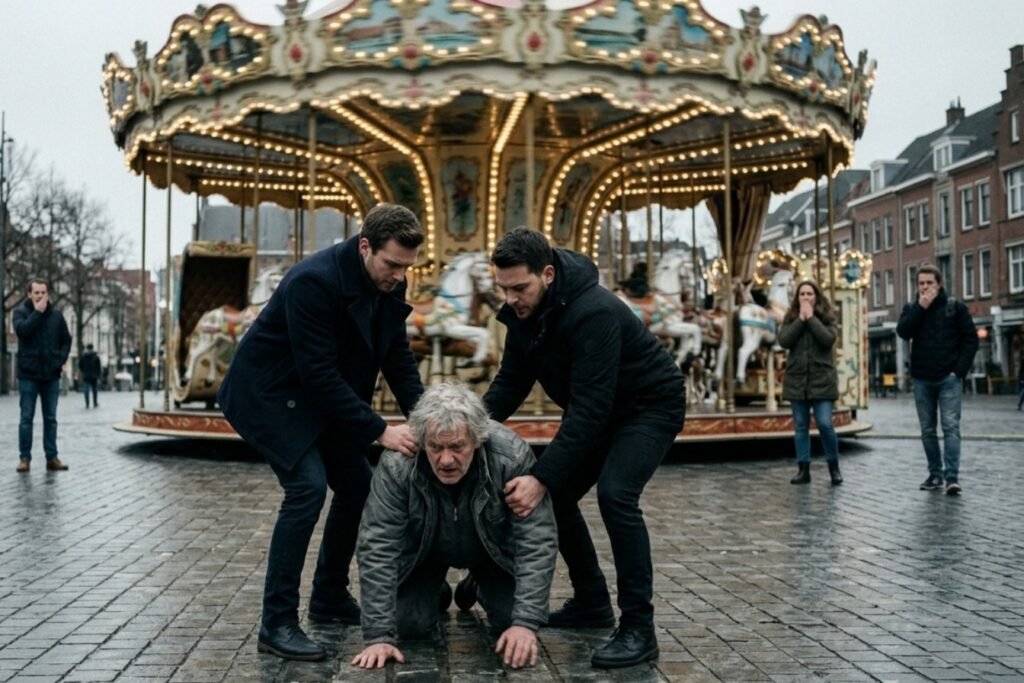
It wasn’t hard, not the way it might look in a movie, not the dramatic crack of a hand across a face that sends someone stumbling. It was a short, sharp motion, Clara’s palm catching the side of Mia’s cheek, and the sound it made was somehow both smaller and louder than anything Noah had ever heard in his life, a single flat clap that seemed to suck all the air out of the kitchen at once.
Mia didn’t cry immediately. She just stood there, one hand pressed to her cheek, staring up at Clara with an expression of such total, uncomprehending betrayal that something in Noah’s chest cracked clean in half.
Then she screamed.
Noah didn’t remember crossing the living room. One second he was on the couch with the purple horse, and the next he was in the kitchen doorway with his sister’s cry ringing in his ears and his phone already halfway out of his pocket, because two weeks ago, after the first time Clara had grabbed Mia’s arm hard enough to leave four small fingerprint bruises, Noah had made a decision that seven-year-olds probably weren’t supposed to have to make.
If nobody was going to believe them, he was going to get proof.
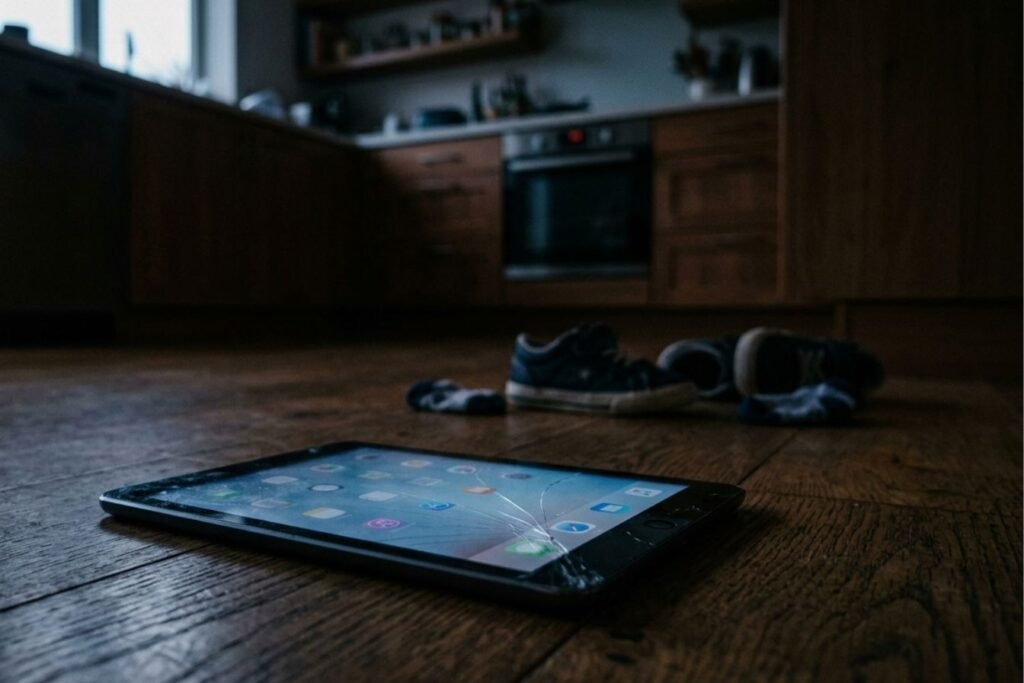
He’d found Dad’s old tablet in the garage, the one that didn’t work for anything anymore except taking pictures, and he’d hidden it, charged, in his backpack every single day since, ready. He’d practiced pulling it out quickly, angling it low so it looked like nothing, like a boy checking a game instead of a boy building a case.
His hands were shaking so badly he almost dropped it. He got it up just in time to catch Clara kneeling down in front of Mia, her own hands pressed to her mouth now, horror flooding into the same face that seconds ago had looked almost unrecognizable.
“Mia, sweetheart, I’m sorry, I didn’t mean—” Clara’s voice cracked entirely. “Oh God, I didn’t mean to do that.”
Mia flinched away from her, pressing herself back against the refrigerator, still holding her cheek, tears streaking silently down her face now instead of screaming.
Noah kept recording. His heart was slamming so hard he could feel it in his throat, but some cold, clear part of him, a part that had grown up too fast somewhere in the last two years, told him not to stop, not yet, not until there was no way for anyone to say this hadn’t happened.
That was the exact moment the front door opened.
Dad wasn’t supposed to be home for another hour. Later, Noah would learn that the dinner with the business partners had been moved, that Dad had swung by early to change his shirt, a small, meaningless scheduling accident that happened to land him in the front hallway at 6:04 in the evening, in perfect earshot of his younger daughter’s scream.
“Mia?” His voice, calling out from the hall, still light, still unaware. “Clara? Everything okay?”
Nobody answered fast enough.
Daniel Hayes came around the corner into the kitchen doorway and stopped dead at the sight in front of him: his daughter pressed against the refrigerator with a red mark blooming high on her cheek, his wife kneeling on the floor with her hands over her own mouth, and his son standing in the doorway holding a tablet up like a shield, his face white as paper.
“What,” Daniel said slowly, in a voice Noah had never once heard him use, “happened to her face?”
Clara stood up too fast, stumbling slightly. “Daniel, it was an accident, I didn’t—she startled me, I never meant to actually—”
“Her face is red, Clara.”
“I know. I know, I’m so sorry, I’ve never—this has never happened before, I swear to you—”
“Dad.” Noah’s voice came out smaller than he wanted it to. “It’s not the first time.”
The kitchen went silent in a way that felt worse than the slap itself.
Daniel turned to look at his son slowly, the way a man turns when he’s afraid of what he’s about to hear and can’t stop himself from hearing it anyway.
“What do you mean, not the first time?”
Noah’s hands were still shaking, but he held the tablet out anyway, screen facing his father, the video still open, the timestamp glowing in the corner: 6:03 PM.
“I recorded it,” he said. “I recorded it because nobody believed us before.”
For a long moment, Daniel didn’t take the tablet. He just stared at his seven-year-old son’s face, and something in his own expression cracked open, guilt and horror and disbelief all fighting for the same small space.
Then he took it, and he watched.
Noah watched his father’s face while he watched the video instead of watching the screen himself. He’d already seen it happen once, live, in the worst thirty seconds of his entire life. He didn’t need to see it again. He needed to see whether his father would believe it.
Daniel’s jaw worked. His hand, holding the tablet, began to tremble slightly by the time the clip ended. When he finally looked up, his eyes had gone glassy and terribly bright, and when he spoke, his voice had dropped to something low and dangerously even, the voice Noah imagined he probably used when a business deal was about to fall apart on him.
“Clara.” He said her name like it cost him something. “Explain this to me. Right now. And don’t you dare tell me it was an accident, because I just watched you do it on purpose.”
Clara had backed herself against the counter, both hands pressed flat against it as if she needed it to stay standing. Her whole body had started to shake, and it wasn’t the shaking of someone caught in a simple lie. It was something closer to the shaking Noah remembered from a nature documentary once, a small animal cornered by something much bigger than itself.
“I can’t,” she said. “I can’t explain it. Not here. Not like this.”
“You’re going to explain it,” Daniel said, “or I am calling a lawyer tonight, and you are never going to be alone with my children again in your life.”
“Daniel, please—”
“Why did you hit my daughter, Clara?”
Something in Clara’s face finally broke, the last piece of composure she’d been holding together by sheer force collapsing all at once. She slid down against the cabinets until she was sitting on the kitchen floor, her knees pulled up, her whole body curling in on itself in a way that looked less like guilt and more, unsettlingly, like grief.
“You don’t understand what happens if I don’t,” she whispered. “You don’t understand what he’ll do.”
Daniel went very still. “What who will do?”
Clara looked up at him, and for the first time since he’d walked through that door, there were tears streaming freely down her face, mixing with something that looked almost like relief, the terrible relief of a secret finally too heavy to carry alone for one more second.
“I have been so afraid,” she said, “for so long, that if I didn’t do exactly what he told me to do, he was going to tell you the truth about how Emma really died.”
The kitchen went so silent that Noah could hear the refrigerator humming, could hear Mia’s breath hitching against his shoulder where she’d pressed herself into his side sometime in the last minute without either of them noticing.
Daniel’s face had gone the color of ash.
“What are you talking about?” His voice had dropped to almost nothing. “Emma died in an accident. There was a police report. There was an investigation.”
“I know what the report says.” Clara’s hands were shaking so badly the words came out unevenly. “I know because I helped write it.”
Somewhere upstairs, a phone buzzed against a hard surface, once, twice, insistent, and Clara’s whole body flinched toward the sound like it belonged to something alive.
“That’s him,” she said quietly. “That’s him right now, wanting to know if I did what he told me to do today.”
Daniel looked from his wife, curled on the kitchen floor with two years of buried terror finally spilling out of her, to the ceiling above them where a phone was still buzzing insistently in their bedroom, and then, last, to his children standing in the doorway, his daughter’s cheek still marked red, his son still holding the tablet that had cracked this entire house open in the space of ninety seconds.
He didn’t know yet who had been threatening his wife for two years, or what they knew about the night his first wife died, or why the safety of his own children had somehow become the currency being used to keep that secret buried.
But he understood, standing in that kitchen with his family in pieces around him, that Clara had not become a monster in his home by accident.
Someone had been building her into one, on purpose, for a very long time.
And whoever that person was, Daniel Hayes intended to find out exactly who, before the sun came up.
Chapter Two: The Name She Couldn’t Say
Daniel put the children to bed himself that night, something he hadn’t done alone in months.
He sat on the edge of Mia’s bed long after her breathing had evened out into sleep, watching the faint red mark on her cheek fade slowly under the nightlight’s glow, and felt something in his chest twist tighter with every minute that passed. In the next room, Noah was still awake, sitting up against his headboard with his knees pulled to his chest, watching his father in the doorway with the wary, evaluating look of a boy who had spent two years learning not to trust that adults would actually do anything once they knew the truth.
“You’re not in trouble,” Daniel said quietly, sitting down on the edge of the bed. “Do you understand that? Not even a little bit.”
“I know,” Noah said, though his voice suggested he hadn’t fully believed it until just now.
“How long have you been recording her?”
“Two weeks. Since she grabbed Mia’s arm and left marks.” Noah’s jaw tightened, working hard to hold something steady in his face that was much too old for a seven-year-old to be holding at all. “I tried to tell you before. About the marks.”
Daniel’s stomach dropped. “When?”
“After school, like a month ago. I said Clara was being mean to Mia a lot. You said grown-ups have hard days sometimes and I should be patient with her.”
The memory landed like a physical blow. Daniel could recall the exact moment now, dimly, distractedly, standing in the kitchen with his phone in one hand and a work email in the other, only half listening to his son, and offering exactly the kind of hollow, convenient answer that let him go back to his email without actually hearing what he’d been told.
“I’m sorry,” Daniel said, and meant it more than he had meant almost anything in his life. “I should have listened. I should have looked closer. That’s on me, not you. You did the one thing I should have been doing all along.”
Noah studied him for a long moment, as if recalibrating something. “Are you going to make her leave?”
“I don’t know yet what I’m going to do,” Daniel admitted. “But I promise you this. Nothing like tonight happens again in this house. Not to you. Not to your sister. Ever.”
He found Clara exactly where he’d left her, sitting at the kitchen table now instead of the floor, her hands wrapped around a mug of tea that had long since gone cold, untouched. Her makeup had run in dark streaks down her face and she hadn’t bothered to fix it, hadn’t bothered with much of anything, staring at the table like a woman waiting for a sentence to be read.
“Start from the beginning,” Daniel said, sitting across from her. “All of it. Or I call the police tonight and let them ask the questions instead.”
Clara flinched at the word police, a full-body flinch that told him more than her next several sentences would.
“His name is Marcus,” she said finally.
Daniel went cold. “Marcus Bell? My business partner?”
Clara nodded, not meeting his eyes.
“I’ve known him for six years,” she said. “Long before I ever met you. I used to work for him. Executive assistant, back when Bell Construction was still just his company, before he brought you in as a partner.” Her hands tightened around the mug. “There was an accident on one of his sites, four years ago. A worker fell because a safety inspection had been falsified to save money on the timeline. Marcus asked me to change a date on a document. Just one date. I did it because he told me it would keep twelve other men employed, and because I believed him when he said no one would ever know.”
“What does that have to do with Emma?”
Clara’s breath caught. For a long moment she didn’t answer, and Daniel thought she might refuse entirely, but then something in her seemed to finally give way completely, two years of silence collapsing all at once.
“The car Emma was driving the night she died,” Clara said slowly, “belonged to Bell Construction’s fleet. A company vehicle, signed out to her because yours was in the shop that week. It had a recall on it. A steering and brake defect, flagged by the manufacturer four months before the accident.” She finally looked up, and her eyes were wet and terrified. “Marcus knew about the recall. He’d known for months. Fixing the entire fleet would have cost more than the company could absorb that quarter, right before a major refinancing deal. He decided to wait until after the deal closed to deal with it.”
The kitchen seemed to tilt slightly around Daniel.
“Emma’s accident,” he said, very quietly, “the police said it was a mechanical failure. They said it was random. Bad luck.”
“It was a mechanical failure,” Clara said. “Just not a random one. Marcus had the paperwork on the recall. I saw it, months after, going through old files for an unrelated audit. A dated internal memo, his signature, deciding to defer the recall repairs.” Her voice cracked entirely. “I confronted him. I told him I was going to take it to the police. And he told me that if I did, he would make sure the falsified inspection report from the fall four years earlier came out too, with my signature on it, and I would go to prison for a death that wasn’t even the one I was trying to expose.”
“So instead,” Daniel said slowly, feeling something like ice spreading through his chest, “he had you marry me.”
“He suggested it,” Clara whispered. “At first I thought—I actually thought, for a while, that maybe it wasn’t only about him controlling you. I thought maybe I could actually build something real, with you, with the kids. For a few months I really believed that.” She pressed the heels of her hands against her eyes. “Then six weeks ago, he found out you’d started asking your insurance company for the original accident file. Some anniversary of Emma’s death made you want to look back at old records, I don’t even know exactly why. He panicked. He told me if I didn’t find a way to make this house so unstable that you’d send the kids to your parents in Denver for a while, so I could clear the office of certain files without them underfoot, without you distracted by parenting instead of grieving all over again and burying yourself in that police report—he would go to the district attorney himself and hand them my signature on that falsified inspection, along with a story that made it sound like I’d known about the fleet recall too, all along.”
“Did you know?” Daniel’s voice had dropped to almost nothing. “About the recall. Before Emma died.”
“No.” Clara looked at him with a desperation that finally, for the first time all night, looked entirely genuine instead of performed. “I swear to you, Daniel, I did not know about that recall until months after she was already gone. I would never have let her drive that car if I’d known. I didn’t even know you yet. I didn’t know your children existed.” Her voice broke completely. “But once I found out, I was already trapped. He made sure of that years before he ever needed me to be.”
Daniel sat in silence for a long moment, staring at a tabletop he’d eaten a thousand meals across, trying to reconcile the woman in front of him with the woman who had slapped his daughter three hours earlier, and finding, to his own quiet horror, that both of those things could apparently be true about the same person at once.
“That doesn’t excuse what you did to Mia,” he said finally.
“I know.” Clara’s voice was barely audible. “There is no version of tonight where what I did to her is forgivable. I’m not asking you to forgive it. I’m asking you to believe that I have spent two years being slowly crushed by a man who murdered your wife and let you bury her without ever knowing the truth, and I let my own fear turn me into someone I don’t recognize, and both of those things are my fault, and I have to live with both of them.”
Upstairs, faintly, Daniel heard the creak of a floorboard, the particular sound of a small body trying very hard to move silently and not quite managing it. He didn’t call out. He simply let it be, understanding that his son had likely been sitting at the top of the stairs listening to at least part of this conversation, and that Noah, after everything, had probably earned the right to know exactly what kind of danger his family had actually been living inside.
“Marcus doesn’t know I’ve told you any of this,” Clara said quietly. “If he finds out, he’ll bury both of us. Me for the inspection report. You, for whatever else he’s willing to invent about tonight, if it comes to that.”
Daniel looked at his phone on the table, at the buzzing that had gone quiet an hour ago but would surely start again by morning, demanding to know why Clara hadn’t checked in.
“Then we’re not going to give him the chance to find out,” he said slowly, an idea beginning to take shape somewhere beneath the horror and grief still roaring through him. “We’re going to get proof of our own. The same way Noah did.”
For the first time since he’d walked through that door, something that wasn’t quite hope, but was at least the shadow of it, crossed Clara’s face.
“You’d help me?” she asked. “After everything?”
“I’m not doing this for you,” Daniel said honestly. “I’m doing this for my wife, who never got to find out the truth about her own death. And for my children, who deserve to grow up in a house that isn’t being run by a man three states away pulling strings through fear.” He stood, his chair scraping back hard against the tile. “But if it happens to get you out from under him too, then I suppose that’s a small, complicated mercy neither of us is really owed tonight.”
Chapter Three: The Paper Trail
The insurance file arrived on Daniel’s desk four days later, requested under the flimsy pretense of a life-insurance audit he invented on the spot, and it took him less than an hour of reading to find what Clara had described with such precision that he’d almost hoped, for her sake, that she’d been wrong.
She hadn’t been wrong. The recall notice was dated fourteen months before Emma’s accident. The internal memo deferring the fleet repairs carried Marcus Bell’s initials in the margin, dated four months before the crash, the same week the company had closed a refinancing deal worth eleven million dollars.
Daniel sat alone in his home office that night with the file spread across his desk and Emma’s photograph propped against the lamp, the one from their last anniversary, and let himself grieve her a second time, in a way that felt almost worse than the first, because this time the grief came bundled with rage that had nowhere honest to go yet.
He couldn’t take the memo to police on its own. He knew that much from six years of working alongside Marcus, watching him navigate three separate lawsuits over the years with the practiced ease of a man who had never once, in Daniel’s presence, been caught without a version of events that made him blameless. A single old memo, however damning, could be explained away as a paperwork error, a miscommunication, a repair scheduled and simply delayed through no one’s malicious intent. Marcus had lawyers on retainer who specialized in exactly that kind of explaining.
What Daniel needed was Marcus, in his own voice, admitting what he’d done and why, the same way Noah’s tablet had turned a deniable moment into an undeniable one.
“He calls Clara every Tuesday and Friday night,” Daniel told her, three days into a plan neither of them had fully admitted out loud they were building together. “Voice, not text, for anything that actually matters. You told me that yourself.”
“He’s careful,” Clara said. “He learned that lesson a long time ago, from other people’s mistakes.”
“Then we make him careless. Just once.” Daniel turned his laptop toward her, showing her a small, innocuous-looking device he’d purchased two days earlier under a different name, shipped to his office instead of the house. “You tell him tonight that I’ve been suspicious. That I asked about the insurance file. Panic him, just slightly, enough that he wants to talk it through with you properly instead of in code.”
Clara stared at the recorder for a long moment. “If he figures out what we’re doing—”
“He won’t,” Daniel said, with more confidence than he entirely felt. “Because you’re not going to do anything different from what you’ve done for two years. You’re just going to let me finally hear it.”
Clara made the call from the kitchen that night, the same kitchen where Mia’s cheek had gone red four days earlier, with Daniel sitting silently at the table beside her, the recorder between them, and Noah and Mia both, at Daniel’s careful insistence, asleep two floors up and nowhere near any of it.
“He’s going to ask about the kids first,” Clara warned quietly, before dialing. “He always does. It’s how he checks whether I’m still following instructions.”
She wasn’t wrong.
“Are they finally settled down?” Marcus’s voice came through the speaker, tinny and pleasant, a businessman’s voice, warm in exactly the calculated way Daniel had spent six years admiring in boardrooms without ever once suspecting what it was capable of covering. “Have you talked to Daniel about Denver yet?”
“I’m working on it,” Clara said, her voice admirably steady. “It’s harder than you think, uprooting two kids that fast without him asking questions.”
“Make it easier, then. I need that office cleared by the fifteenth, Clara, not the twentieth.”
“Cleared of what, exactly?” Clara asked, glancing at Daniel. “You’ve never actually told me what’s still in there.”
There was a pause on the line, brief but unmistakable, the sound of a careful man deciding how much to say to someone he believed he’d already broken completely.
“The original fleet maintenance logs,” Marcus said finally, his voice dropping lower. “The physical ones, before we digitized. I thought I’d destroyed them years ago, but my old assistant apparently boxed up the wrong year during the office move. If Daniel’s insurance company gets anywhere near those, they’ll see the recall paperwork with my signature dated four months before his wife’s accident, and no amount of lawyers is walking me back from that.”
“And if I can’t get them cleared in time?”
“Then you remember,” Marcus said, and his voice had gone from pleasant to something flat and cold in the space of half a sentence, “that I still have the falsified inspection report with your name on it, and a very believable story about how you knew about that recall long before Emma Hayes ever got behind the wheel of that car. I will use it, Clara. I have spent two years being patient with you. That patience is not unlimited.”
Clara’s hand, resting on the table, had gone white-knuckled around the edge of it. Beside her, Daniel sat frozen, staring at the small blinking light on the recorder as if he could will it to capture every word more permanently just by looking at it hard enough.
“I understand,” Clara said quietly. “I’ll have it done.”
“Good,” Marcus said, warmth sliding back into his voice as easily as it had left. “This is almost over, Clara. Once those logs are gone, there’s nothing left connecting me to any of it. You’ll finally be able to stop worrying.”
The call ended. For a long moment, neither Daniel nor Clara moved, both of them staring at the small device between them that now held, in Marcus Bell’s own unmistakable voice, a confession to withholding a known safety defect that had killed Emma Hayes, and to blackmailing his own business partner’s wife into covering it up.
“That’s it,” Daniel said finally, his voice hoarse. “That’s everything.”
Clara let out a breath that sounded like it had been trapped in her chest for two solid years.
“What happens now?” she asked.
Daniel looked toward the ceiling, toward the two small bedrooms above them where his children were finally, mercifully, asleep, unaware that the truth about their mother’s death had just been recorded ten feet below them by the very woman who had hurt one of them four nights earlier.
“Now,” he said, “we make sure he never gets the chance to touch this family again.”
Chapter Four: The Fifteenth
Marcus Bell had built his entire life around never being caught without a contingency, which was exactly why, on the morning of the fifteenth, he arrived at the Hayes house himself instead of trusting the office clearing to anyone else.
Daniel hadn’t expected that. Neither had Clara, whose face went the color of paper when she looked out the front window and saw Marcus’s black sedan pulling into the driveway, twenty minutes earlier than anyone had planned for.
“He never comes here,” Clara said, her voice tight with sudden panic. “Never. He’s always been careful about that.”
“Something spooked him,” Daniel said grimly, already moving toward the stairs. “Get the kids into my office. Lock the door. Don’t open it for anyone but me.”
Noah didn’t ask questions when Daniel appeared in the doorway of his room, simply took Mia’s hand and followed his father down the hall with the quiet, practiced compliance of a boy who had learned, in the space of one terrible week, exactly how fast a house could turn dangerous.
By the time the doorbell rang, Daniel was standing in the front hallway alone, the recording already sent, on his instruction, to a personal email account Marcus Bell had no access to, along with the insurance file and a message to a lawyer Daniel trusted completely, timestamped and waiting to be opened automatically in six hours unless Daniel personally logged in to stop it.
He opened the door to find Marcus standing on the porch with the same easy, confident smile he’d worn in a hundred boardroom meetings, though something behind his eyes looked sharper than usual, more alert.
“Daniel.” Marcus stepped past him into the hallway without waiting for an invitation, the way he always did, the small habitual arrogance of a man used to owning every room he entered. “I was in the area. Thought I’d check in on the family myself, given everything going on with Clara this week.”
“What’s going on with Clara this week?” Daniel asked evenly.
Something flickered across Marcus’s face. “She mentioned some tension in the house. I wanted to see how everyone was holding up.”
“We’re holding up fine,” Daniel said. “Better than fine, actually, now that I know exactly what’s been causing the tension.”
Marcus went very still.
“I’m not sure what you mean.”
“I think you are.” Daniel reached into his jacket pocket and set his phone on the hallway table between them, the recording already cued, and pressed play.
Marcus’s own voice filled the hallway, tinny but unmistakable: the recall paperwork with my signature dated four months before his wife’s accident.
Marcus’s face drained of color in real time, the practiced confidence sliding off him so completely and so fast that Daniel almost, almost, felt something like pity watching it happen.
“Where did you get that,” Marcus said, his voice gone flat and dangerous in a way Daniel had genuinely never heard from him in six years of partnership.
“From the same place I got the insurance file. And the original memo, with your initials on it, deferring a known brake and steering defect four months before it killed my wife.” Daniel’s own voice had dropped to something low and absolutely unshakable. “It’s already sent to my lawyer, Marcus. It sends itself automatically to the police and to three separate journalists in six hours unless I personally stop it, and I promise you, there is no version of the next six hours where I feel like stopping it.”
“You don’t understand what you’re about to do to this company,” Marcus said, something desperate creeping into his voice now, the first genuine crack Daniel had ever seen in fifteen years of knowing him. “To your own family’s finances. To—”
“To you,” Daniel said quietly. “You mean what I’m about to do to you.” He stepped forward until there was almost no space left between them. “You let my wife drive a car you knew was dangerous, because fixing it would have cost you money at exactly the wrong moment. Then you spent two years terrorizing a woman into abusing my children, to keep me from ever finding that out.” His hands had curled into fists at his sides without his fully realizing it. “There is nothing left for you to threaten me with, Marcus. You already took the worst thing you could ever take from this family. Everything after that is just consequences.”
Upstairs, faintly, Daniel heard the office door creak open despite his instructions, and looked up to see Noah standing at the top of the stairs, tablet in hand once again, the small red recording light glowing steadily.
Marcus followed his gaze and understood, a half-second too late, exactly what had just happened for the second time in one week in this house.
“Smart kid,” he said bitterly, something like defeat finally settling into his voice.
“He learned it from watching what happens when nobody believes you the first time,” Daniel said. “I’d say he learned the lesson well.”
The police arrived eleven minutes later, called not by Daniel but by his lawyer, exactly as planned, and Marcus Bell was led out of the house in handcuffs past a hallway table still holding a phone with his own recorded voice on it, past a stairway where a seven-year-old boy stood watching with an expression that held far more relief than fear.
Chapter Five: What Was Left to Rebuild
The months that followed were not simple, and Daniel had stopped expecting them to be.
Marcus Bell was charged with manslaughter, evidence tampering, and obstruction, the fleet maintenance records recovered from the very office Clara had been ordered to clear proving, in exhaustive and damning detail, exactly how long he had known about the defect and exactly how much money he had saved by ignoring it. The trial would take over a year to reach its conclusion, but the confession recording alone, combined with the physical documents, made the outcome feel less like a question and more like a formality everyone was simply waiting to arrive.
Clara’s situation was more complicated, and Daniel never pretended otherwise, not to himself and not to his children.
She was charged, eventually, with the falsified inspection report from years earlier, a separate and genuine crime that existed independently of anything Marcus had done to her since. She cooperated fully, provided everything she had, and her lawyer argued, with considerable evidence behind it, that two years of coercion under threat of exposure deserved real weight in how the courts weighed her culpability. What happened to Mia in that kitchen was never folded into any of it, never excused by it, and Clara herself, in the one difficult conversation she and Daniel had about it before she moved out permanently, refused to let it be.
“I’m not going to stand here and tell you it wasn’t really me,” she said quietly, sitting across from him one last time at the kitchen table, her bags already packed in the car outside. “Being afraid explains why I broke. It doesn’t make the break not mine.”
She started therapy the same week, court-mandated at first and then, as far as Daniel later heard through the quiet channels divorced families sometimes still share, continued long after it stopped being required. He didn’t know if he would ever fully forgive her, and he told her honestly that he didn’t think that was a question he owed an answer to yet, possibly ever. But he found, to his own surprise, that he no longer needed her to be a simple villain in order to protect his children from her. She could be a woman who had been slowly, deliberately broken by someone far more dangerous than she was, and still, separately, be someone who was never allowed near his family unsupervised again. Both things were true. He had learned, in the space of one terrible week, that most real things usually were more than one thing at once.
Noah asked, three weeks after Marcus’s arrest, whether he’d done something wrong by recording it all in secret instead of just telling an adult and trusting them to fix it.
Daniel sat with that question for a long moment before answering, because it deserved more than a reflexive comfort.
“You did something I wish you’d never had to learn how to do,” he said finally. “No seven-year-old should have to figure out that grown-ups sometimes need proof before they’ll believe the people they love. That’s on me, and it’s on every adult in your life who made you feel like your words alone weren’t going to be enough.” He pulled his son into a hug that Noah, for once, didn’t try to wriggle out of early. “But you didn’t do anything wrong. You protected your sister when the person who was supposed to protect both of you couldn’t be trusted to. That’s not something to apologize for. That’s something I hope you never have to do again, but that I will always, always be proud of you for doing when it mattered.”
Mia, for her part, mostly just wanted her horse coloring book back, and to know whether Clara was “still mad about the juice.”
“She was never mad about the juice, sweetheart,” Daniel told her gently, smoothing her hair back from her face. “She had a lot of big, scary things happening that had nothing to do with you at all. None of what happened was because of anything you did.”
Mia considered this with the particular seriousness of a five-year-old working through a concept slightly too large for her yet, then nodded and asked if she could color a purple horse for Noah too, since he’d been sad lately and purple horses, in her considered five-year-old opinion, fixed almost everything.
On the one-year anniversary of the night everything had come apart in that kitchen, Daniel found the old tablet again, still in the bottom drawer of Noah’s desk where it had lived ever since, its battery long dead, its screen slightly cracked along one corner from being carried around in a backpack for two protective weeks by a boy who hadn’t trusted anyone else to keep his sister safe.
He didn’t throw it away. He charged it instead, backed up the one video still saved on it into a folder he never intended to watch again but also could never quite bring himself to delete, and gave it back to Noah with a promise instead: that from now on, in this house, the truth wouldn’t need to be secretly recorded to be believed.
It would simply be listened to, the first time, by someone who had finally learned better than to look away.
THE END