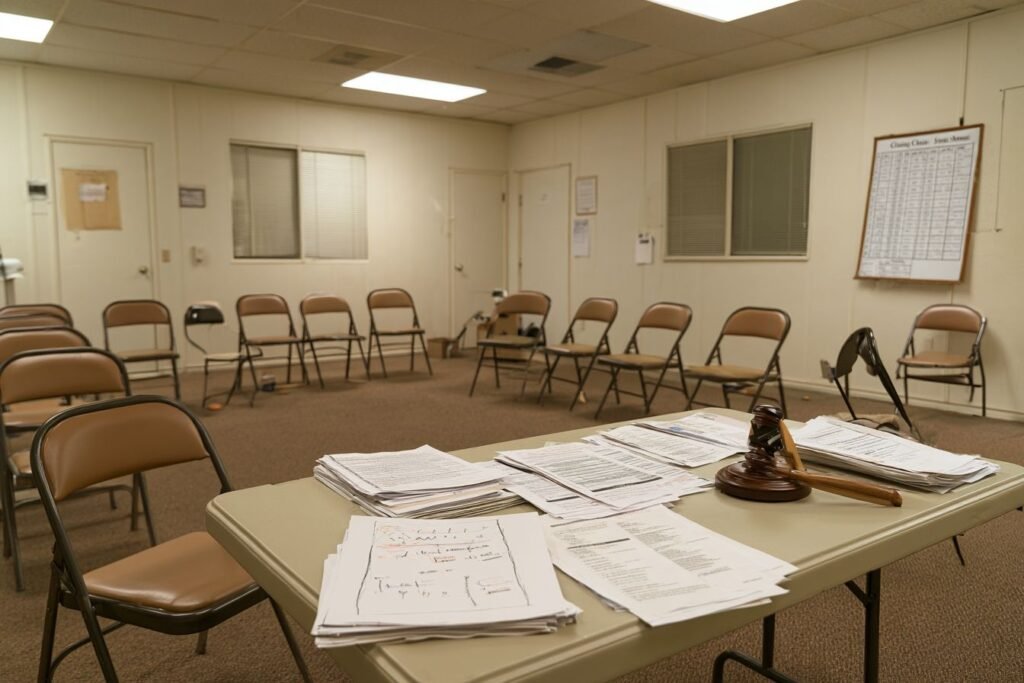
The HOA meets in the clubhouse, which is a single beige room with folding chairs, a coffee machine nobody trusts, and a corkboard displaying the minutes from every meeting since the neighborhood was built, none of which, as far as I can tell, anyone has ever read. I arrived with Dave, who had, against my explicit instructions, brought a folder.
“What’s in the folder,” I said.
“Research,” Dave said, which did not reassure me even slightly.
Deborah ran the meeting the way I imagine a small, extremely tidy country might be run, with an agenda, a gavel she did not technically need but clearly enjoyed using, and a seating chart that placed Dave and me directly in front of the board, like defendants, which, functionally, we were. Item four, after a lengthy discussion about mailbox paint colors that I will never get back the twelve minutes of my life I spent on, was us.
“Mr. Reyes and Mr. Whitfield,” Deborah said, using our full names in a way that made us both sit up straighter, “are believed to be harboring livestock in violation of section four, subsection C.”
Dave stood up before I could stop him and opened the folder. Inside were printouts, actual printouts, of egg prices at three local grocery stores, a chart, hand drawn, comparing “store egg” to “Henrietta egg” on a scale of freshness that I am fairly sure Dave invented on the spot, and, inexplicably, a photograph of Henrietta looking, in fairness, extremely photogenic, backlit, almost regal, like a portrait someone had commissioned.
“This is not a violation,” Dave announced to the room. “This is a public service.”
Deborah did not look moved by the chart. She looked, if anything, more suspicious, the way you look at a man who has clearly prepared too much for something he claims wasn’t a big deal. But something happened that neither of us had planned for. My neighbor from two doors down, a woman named Priti who I had spoken to maybe four times in three years, raised her hand and said, quietly, that she had actually been getting eggs from Dave for two weeks, and they were, in her words, “genuinely better,” and she didn’t see the harm.
Then another neighbor said the same thing. Then another. It turned out Dave had been running a small, entirely unofficial egg distribution ring throughout the neighborhood for weeks, and I, Henrietta’s actual landlord, had been the last to know.
Deborah looked at the room, at the small but growing group of people nodding along about egg quality, and I watched something shift in her, the specific expression of a woman realizing she was about to lose a vote she had not expected to be a vote at all.
“One chicken,” she said finally, “kept in appropriate, contained, and sanitary conditions, with neighbor approval, may be permitted on a probationary basis, subject to review.”
Dave pumped his fist like we’d won a championship. I mostly felt relief, and also a strong, specific dread about the phrase “sanitary conditions,” which I understood to mean Henrietta’s garage era was officially over and a real coop was now a legal requirement rather than a nice idea.
We built the coop the following weekend. Actually built, with real wood, in the backyard, in full view of everyone, no tarps required. Henrietta seemed to approve, or at least stopped shrieking at dawn, which in her language I choose to interpret as approval.
Anna, watching Dave and me struggle with a level for the better part of an hour, said she never in a hundred years thought she’d be married to a man who won an argument in front of the HOA using a chart about egg freshness that his friend drew by hand. I told her that was, in fact, the most romantic thing that had ever happened to me, and she said that explained a lot about our marriage.
Henrietta, for her part, laid an egg that afternoon, in her brand new, fully legal coop, and Dave insisted we eat it together, split three ways with Priti, to celebrate. It was, I will admit, a very good egg.